Sadam Hussain Biography
Saddam, which means "he who confronts," was born in a village called al-Auja, outside of Tikrit in northern Iraq. Either just before or just after his birth, his father disappeared from his life. Some accounts say that his father was killed; others say he abandoned his family.
Saddam's mother soon remarried a man who was illiterate, immoral, and brutal. Saddam hated living with his stepfather and as soon as his uncle Khairullah Tulfah (his mother's brother) was released from prison in 1947, Saddam insisted that he go and live with his uncle.
Saddam didn't start primary school until he moved in with his uncle at age 10. At age 18, Saddam graduated from primary school and applied to military school. Joining the military had been Saddam's dream and when he wasn't able to pass the entrance exam he was devastated. (Though Saddam was never in the military, he frequently wore military-style outfits later in life.)
Saddam then moved to Baghdad and started high school, but he found school boring and enjoyed politics more.
Saddam's uncle, an ardent Arab nationalist, introduced him to the world of politics. Iraq, which had been a British colony from the end of World War I until 1932, was bubbling with internal power struggles. One of the groups vying for power was the Baath Party, to which Saddam's uncle was a member.
In 1957, at age 20, Saddam joined the Baath Party. He started out as a low-ranking member of the Party responsible for leading his schoolmates in rioting. However, in 1959, he was chosen to be a member of an assassination squad. On October 7, 1959, Saddam and others attempted, but failed, to assassinate the prime minister. Wanted by the Iraqi government, Saddam was forced to flee. He lived in exile in Syria for three months and then moved to Egypt where he lived for three years.
In 1963, the Baath Party successfully overthrew the government and took power which allowed Saddam to return to Iraq from exile. While home, he married his cousin, Sajida Tulfah. However, the Baath Party was overthrown after only nine months in power and Saddam was arrested in 1964 after another coup attempt. He spent 18 months in prison, where he was tortured, before he escaped in July 1966.
During the next two years Saddam became an important leader within the Baath Party. In July 1968, when the Baath Party again gained power, Saddam was made vice-president.
Over the next decade, Saddam became increasingly powerful. On July 16, 1979, the president of Iraq resigned and Saddam officially took the position.
Saddam Hussein ruled Iraq with a brutal hand. He used fear and terror to stay in power.
From 1980 to 1988, Saddam led Iraq in a war against Iran which ended in a stalemate. Also during the 1980s, Saddam used chemical weapons against Kurds within Iraq, including gassing the Kurdish town of Halabja which killed 5,000 in March 1988.
In 1990, Saddam ordered Iraqi troops to take the country of Kuwait. In response, the United States defended Kuwait in the Persian Gulf War.
On March 19, 2003, the United States attacked Iraq. During the fighting, Saddam fled Baghdad. On December 13, 2003, U.S. forces found Saddam Hussein hiding in a hole in al-Dwar, near Tikrit.
After a trial, Saddam Hussein was sentenced to death for his crimes
Amitabh Bachan Biography
Date of Birth
11 October 1942, Allahabad, Uttar Pradesh, India
Birth Name
Amitabh Harivansh Srivastav
Nickname
Big B
Munna
One Man Industry
Angry Young Man
Bollywood's Shahenshah
Amith
AB Sr.
Height
6' 2" (1.88 m)
Mini Biography
Son of well known poet Harivansh Rai Bachchan and Teji Bachchan. He has a brother named Ajitabh. He completed his education from Uttar Pradesh and moved to Bombay to find work as a film star, in vain though, as film-makers preferred someone with a fairer skin, and he was not quite fair enough. But they did use one of his other assets - his deep baritone voice - which was used for narration and background commentary. He was successful in being cast in Saat Hindustani. He got his break in Bollywood after a letter of introduction from the then Prime Minister Mrs. Indira Gandhi, as he was a friend of her son, Rajiv Gandhi. This is how Amitabh made an entry in Bollywood, starting with Zanjeer, co-starred with his future wife Jaya Bhaduri, and since then there has been no looking back.
He married Jaya Bhaduri, an actress in her own rights, and they had two children, Shweta and Abhishek. Shweta is married, lives a non-filmy life and has two children.
Being friends with Rajiv Gandhi, got him to decide to run for seat in the Congress from his hometown but had to leave midterm because of controversies, particularly after Rajiv and he were implicated in the now infamous "Bofors" case along with the U.K. based Hinduja Brothers.
After a four year break, he was back in the unsuccessful Mrityudaata (1997), a comeback which the actor wanted to forget. Critics written him off but his career was saved with Bade Miyan Chote Miyan (1998). But four flops in 1999 and incurring debt of over 90 Crores rupees of his sinking company ABCL saw him at an all-time low. To make matters worse, after the defeat of the Congress party, Amitabh lost considerable political support, the opposition made him a target, and his credit rating deteriorated to such an extent that a leading nationalized bank, Canara Bank, sued him for outstanding loans. He did bounce back, presenting the Indian version of Who Wants To Be A Millionaire called "Kaun Banega Crorepati?" (2000). After a series of hits with Mohabbatein (2000), Kabhi Khushi Kabhie Gham... (2001) and Baghban (2003) and Khakee (2004), this elderly Bachchan is showing no signs of slowing down and proving the critics wrong once again.
His son, Abhishek, is also an actor by his own rights.
Amitabh and Jaya were interested in getting Abhishek married to Karishma, the daughter of Babita and Randhir Kapoor, they went through a formal engagement, but later broke it off.
The former Miss World and Bollywood actress, Aishwarya Rai, and Abhishek, were formally engaged on Sunday January 14, 2007, at the Bachchan residence in Juhu, Bombay, with the marriage taking place at the Bachchan residence on April 20, 2007.
On November 16, 2011, he became a Dada (Paternal Grandfather) when Aishwarya gave birth to a daughter in Mumbai Hospital. He is already a Nana (maternal grandfather) to Navya Naveli and Agastye - Shweta's children b
. Amitabh Bachan
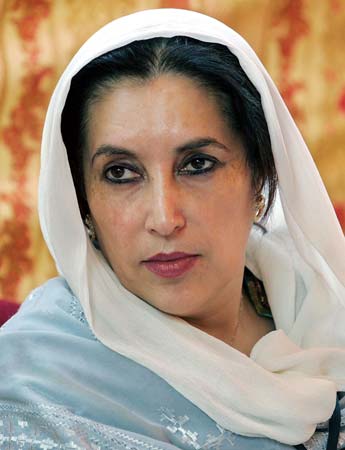
Shaheed Benazir Bhutto Biography
Benazir Bhutto was born on June 21, 1953, in Karachi, SE Pakistan, the child of former premier Zulfikar Ali Bhutto. She inherited leadership of the PPP after a military coup overthrew her father's government and won election in 1988, becoming the first female prime minister of a Muslim nation. In 2007 she returned to Pakistan after an extended exile, but was killed in a suicide attack.Public figure. Benazir Bhutto was born June 21, 1953, in Karachi, SE Pakistan, the eldest child of former premier Zulfikar Ali Bhutto. He founded the Pakistan People's Party (PPP) and was prime minister from 1971 to 1977. After completing her early education in Pakistan, she pursued her higher education in the United States. From 1969 to 1973, she attended Radcliffe College, and then Harvard University, where she graduated with a B.A. degree in comparative government. It was then onto the United Kingdom to study at Oxford from 1973 to 1977. There, she completed a course in International Law and Diplomacy.
Bhutto returned to Pakistan in 1977, and was placed under house arrest after the military coup led by General Mohammad Zia ul-Haq overthrew her father's government. One year after Zia ul-Haq became president in 1978, the elder Bhutto was hanged after his conviction on charges of authorizing the murder of an opponent. She inherited her father's leadership of the PPP.
There was more family tragedy in 1980 when Bhutto's brother Shahnawaz was killed in his apartment on the Riviera in 1980. The family insisted he was poisoned, but no charges were brought. Another brother, Murtaza, died in 1996 (while his sister was in power) in a gun battle with police in Karachi.
She moved to England in 1984, becoming the joint leader in exile of the PPP, then returned to Pakistan on April 10, 1986, to launch a nationwide campaign for 'open elections.
She married a wealthy landowner, Asif Ali Zardari, in Karachi on December 18, 1987. The couple had three children: son Bilawal and two daughters, Bakhtawar and Aseefa.
Benazir Bhutto
Benazir Bhutto
Benazir Bhutto
Benazir Bhutto
Benazir Bhutto
Benazir Bhutto
Benazir Bhutto
Benazir Bhutto
Benazir Bhutto
Benazir Bhutto - (Aslam Ramay) "PPP" Multan,Pakistan
Zulfqar Ali Bhutto Biography
Zulfikar Ali Bhutto was born on January 5, 1928, in Larkana, a small town in the province of Sind. Although he came from a major landowning family in Larkana, he was brought up in cosmopolitan Bombay, away from the feudal environment of his ancestral home. After completing his high school education in Bombay, he proceeded to the University of California at Berkeley from which he graduated in 1950 with a Bachelor of Arts degree in political science. At Berkeley he became interested in socialism and delivered several lectures on the feasibility of socialism in Islamic countries--a theme which would dominate his party's manifesto 20 years later. Bhutto continued his education at Oxford, where he studied law.
Bhutto advocated a nonaligned foreign policy for Pakistan and opposed Pakistan's alliances with the United States. He believed that the United States was exerting pressure on Pakistan to adopt a conciliatory attitude towards neighboring India. The lingering post-partition animosity between India and Pakistan influenced Bhutto's hard-line thinking towards India. He was intent on gaining international support against India and securing Pakistan from a possible Indian attack. With this in mind Bhutto cultivated relations with China, which had been involved in a border conflict with India in 1962. Bhutto's astuteness in developing relations with China was later useful for the Nixon administration, which used Pakistan as a channel for initiating a dialogue with China. Bhutto also sought to strengthen relations with other Islamic countries, envisaging Pakistan's role as a leader not only of Muslim countries but also of other developing states.
Pakistan had been under military rule by a government headed by Ayub Khan since 1958. Bhutto, who served as minister of foreign affairs until asked to resign in 1966, realized that the toleration of the people for repressive government was diminishing. He felt that this adverse situation presented an ideal opportunity for him to assume leadership of Pakistan. In December 1967 Bhutto formed his own political party, the Pakistan People's Party, whose manifesto promised to alleviate the lot of the urban and rural workers and advocated an equitable distribution of wealth. His program not only appealed to the lower income groups but was supported by the urban intelligentsia which was seeking an end to the military regime and felt that Bhutto offered a new and dynamic plan and a necessary alternative to traditional religious parties.
Pakistan's defeat in the 1971 war with India led to the creation of Bangladesh. Bhutto, with the strongest party in the remaining western wing of the country, replaced Gen. Mohammad Yahya Khan as president. In April 1973 Bhutto became prime minister under a new constitution. His six years in office were marked by extensive nationalization of industries, banks, and educational institutions. Bhutto's policies, aimed at reducing the power of such traditional economic forces as major businessmen and feudal landlords, were well intentioned but lacked sufficient consideration of economic realities. His government's economic policies were implemented hastily by bureaucrats who did not have the requisite management skills and background. Consequently, the economy became chaotic and left most sections of society disaffected with the policies. Bhutto's frequently touted slogan of "Islamic Socialism" proved to be mere rhetoric in the face of daunting economic and social realities, especially the need to compromise with landed elites.
Confronted by increasing opposition, Bhutto introduced repressive measures which included press censorship and imprisonment of political opponents. In an attempt to show the "democratic" nature of his government and his continuing popular support, Bhutto decided to hold general elections in March 1977. Confident of his success, he underestimated the collaboration of the opposition parties. Although he won the 1977 elections, his opponents accused him of flagrant manipulation of votes and mounted a civil disobedience movement against his government. As public discontent and violence spread, Bhutto was forced to impose martial law in several major cities of Pakistan, paving the way for military involvement. He was deposed in a bloodless coup by Gen. Zia ul-Haq on July 5, 1977. Several charges were brought against him, including the murder while in power of a political opponent's father. He was sentenced to death and was hanged on April 4, 1979, despite appeals for clemency by world leaders and international organizations.
While Bhutto's policies in the domestic sphere were harshly criticized, his foreign policy won him some acclaim. He was intent on asserting Pakistan's role in international affairs and strove to fulfill his earlier ideal of Pakistan as a leader of developing countries. He attempted to pursue a foreign policy independent of both superpowers, which brought him into considerable conflict with the United States, especially over the issue of Pakistan's nuclear program.
In 1986, after two years of self-imposed exile, Benazir Bhutto, daughter of the executed president, returned to Pakistan. She became Prime Minister in 1988.
Zulfqar Ali Bhutto
Zulfqar Ali Bhutto
Zulfqar Ali Bhutto
Zulfqar Ali Bhutto
Zulfqar Ali Bhutto
Zulfqar Ali Bhutto
Zulfqar Ali Bhutto
Zulfqar Ali Bhutto
Zulfqar Ali Bhutto
A Great Leader in History of Pakistan Zulfiqar Ali Bhutto Shaheed Part (2)
Zulfikar Ali Bhutto addresses to 2nd Islamic Summit Conference at Lahore on 24-02-1974. wmv
Amir Khan Biography
With his penchant for perfection and professionalism, Aamir Khan is one of the few method actors in Bollywood, who has taken acting to a whole new level. An actor, director, producer, playback singer, a state tennis champion, and mentor to his nephew (Imran Khan) – he’s all that and more.
Aamir was born in Mumbai to a Muslim family that has been actively involved in the Indian motion picture industry for several decades. His father, Tahir Hussain, was a film producer while his uncle, Nasir Hussain, was a film producer, as well as a director and an actor. Aamir has three siblings Faisal, Farhat, and Nikhat. His cousin Mansoor Khan is a director.
Aamir Khan was first introduced as a child artiste in the 1970′s hit Yaadon Ki Baaraat (1973). He made his adult acting debut in a role that went quite unnoticed in Ketan Mehta’s Holi (1984). His first notable leading role came in 1988 in the film Qayamat Se Qayamat Tak which was directed by his cousin Mansoor Khan. This film was a breakthrough commercial success, effectively launching Khan’s career as a leading actor. Having the typical ‘chocolate hero’ looks, he was publicised as a teen idol. He also starred in critically acclaimed film Raakh (1989). Aamir went on to appear in several other films in the late ’80s and early ’90s: Dil (1990), which became the highest grossing film of the year, Dil Hai Ke Manta Nahin (1991), Jo Jeeta Wohi Sikandar (1992), Hum Hain Rahi Pyar Ke (1993) (for which he also wrote the screenplay), and Rangeela (1995). Most of these films were commercially successful and critically acclaimed. Aamir’s other successes include Andaz Apna Apna: the movie was reviewed unfavourably by critics, but has, over the years, gained a cult status.
Aamir’s only release in 1996 was the Dharmesh Darshan directed commercial blockbuster Raja Hindustani. In 1997, he co-starred with Ajay Devgan and was paired opposite Juhi Chawla in the film, Ishq, which did well at the box office. In 1998, Khan appeared in the moderately successful Ghulam, for which he sang the hot song, ‘Aati Kya Khandala’. John Mathew Matthan’s Sarfarosh and Deepa Mehta’s Earth 1947 were Khan’s releases in 1999. His first release for the new millennium, Mela, in which he acted alongside his real-life brother Faisal Khan, failed at the box office.
In 2001 he appeared in Lagaan, which was also his first home production. The film was a major critical and commercial success, and received a nomination for Best Foreign Language Film at the 74th Academy Awards. The success of Lagaan was followed by the Farhan Akhtar directed, Dil Chahta Hai.
Khan then took a four year break citing personal problems, and returned in 2005 with Ketan Mehta’s Mangal Pandey: The Rising. The film didn’t fare well at the box office. Rakeysh Omprakash Mehra’s award-winning Rang De Basanti was Khan’s first release in 2006. His role was critically acclaimed. Fanaa was his second release in 2006, where he starred opposite Kajol.
In 2007, Aamir took on the role of director for his second home production, Taare Zameen Par. In 2008, Khan appeared in the movie Ghajini that broke many box-office records. In the same year, Khan launched his nephew Imran Khan in another film from his production house, Jaane Tu Ya Jaane Na.
In 2009, Khan appeared in the commercially and critically acclaimed film, 3 Idiots, as Ranchodas Chanchad. The Rajkumar Hirani directed film went on to become Bollywood’s highest grossing film.
In 2010, Aamir released, under his banner, the critically acclaimed film, Peepli Live, that was based in a rural setting. Aamir returned to big screen with his fourth production Dhobi Ghat, written and directed by his wife, Kiran Rao, in 2011.
Aamir is currently shooting for Reema Kagti’s next film. His fifth home production, Delhi Belly, is scheduled to release in July 2011.
Pervez Musharrf Biography
President Musharraf addressing the nation.
General Pervez Musharraf, the second of three brothers, was born in Delhi on August 11, 1943. His parents chose to settle in Karachi after the creation of Pakistan. He comes from a middle class family, his father having worked for the foreign ministry. He spent his early years in Turkey, from 1949 to 1956, owing to his father, the late Syed Musharrafu-ud-din’s deputation in Ankara. Fluently he can converse in Turkish language and claims that Kamal Ataturk is his hero.
On return to Pakistan, General Pervez Musharraf received his education from Saint Patrick's High School, Karachi, and then from F. C. College, Lahore. In 1961, he joined the Pakistan Military Academy and was commissioned in Artillery Regiment in 1964. He fought in the Indo-Pakistan War of 1965 as a young officer, and was awarded Imtiazi Sanad for gallantry. He also achieved the Nishan-i-Imtiaz (Military) and the Tamgha-i-Basalat. He has been also on the faculty of the Command and Staff College, Quetta and the war wing of (the) National Defence College. He volunteered to be a commando, and remained in the Special Services Group for seven years. He also participated in the Indo-Pak War of 1971 as a Company Commander in the Commando Battalion.
Pervez Musharrf
Pervez Musharrf
Pervez Musharrf
Pervez Musharrf
Pervez Musharrf
Pervez Musharrf
Pervez Musharrf
Pervez Musharrf
Pervez Musharrf
Ex President of Pakistan Pervez Musharaf Dancing with Chitral Polo Team
Imran Khan Biography
He dazzled the world with his amazing talent, he gave cricket another name, he
is and always will be remembered by cricket fans worldwide. Imran khan, an
unbelievably talented all rounder is the Legend of cricket and has reached the
top like no one else.
This cricketer was born no differently than any other person. He was born in
Lahore, Pakistan into a family of six. He entered the world on November 25,
1952, the only boy and seventh member of his family. His parents gave him the
name Imran Khan Niazi and truly loved him since he is the only boy in their
family.
Imran was part of a well-educated family. His parents believed that their
children should get the best of education, and become something. Imran's parents
have believed this and followed through with it, and that is why Imran's sisters
are so successful today. His older sister Robina is an alumnus of the LSE and
has a senior position in the United Nations in New York; his other sister Aleema
has a master's degree in business administration and runs a successful business;
Uzma is a highly qualified surgeon is working in a Lahore hospital; while his
other sister Rani is a University graduate who coordinates charity work. When it
was time for Imran to go attend a college, he went to the prestigious public
school in Lahore, the Aitchison College. There he was by far the best player on
his team, being a very fine batsmen. He was still though quite far from becoming
the best in the world. As Imran grew older, his interests went from being a
batsmen to being a fast bowler.
When sixteen, Imran made his debut for Lahore. Imran's cousins Javed Burki, and
Majid Khan were a great part of cricket therefore when he made his test debut
people thought that he made it because his family was on the Pakistan's Cricket
Team. (Nepotism)
Later, Imran had to put cricket to the side and focus more on his studies.
Undoubtedly he was back again at the age of eighteen. He played admirably which
resulted in him moving to England as he was chosen to play for a private school
there.
As the year 1971 approached, he made his test debut while visiting England.
During this tour, he was fined many times by the management because he was
looked upon by his peers as being a very snobby and wild player. Also on this
tour, Imran did not play as well. Because of his "not so good" bowling, Pakistan
was costed to settle for a draw. This was the only test match on the tour.
When Imran was twenty-one, he was admitted in the Oxford University. For three
years he studied economics and politics. In 1974 Pakistan toured England and
therefore he was selected because of his form for Oxford University and his
experience with speaking English. He had not succeeded to make a big mark
because all three of his tests were drawn.
In 1976 Imran returned to Pakistan after being away for four years. During the
1976-77 season, Imran got a place in the Pakistan cricket team. He had impressed
the team with his fantastic bowling. Later he moved to play with Sussex. The
biggest reason for Imran to do this was because of his love affairs with the
nightlife of London. He was quite angry at Worcester (a team he played for
before he played for Sussex), because of the racism he found there. During the
time he had been playing for other teams, Imran had become quite a big star.
Everyone was able to see that this guy had talent and played very well. At this
point, not only was he playing well, but had basically become a superstar.
Imran continued to play for Sussex, because he enjoyed it there. At this point
he had become the "father" of the reverse swing. His most famous partner was
Sarfaraz Nawaz, in which the partners could make a lot of runs.
Soon after, under the orders of the top official, Imran came back to Pakistan
to play test cricket for the series against India. During this match, Imran hit
two sixes and a four with only seven balls remaining. Because of Imran's huge
success, one could easily say that Imran was one of the most adored cricketer
through the land at this point.
During the early 80's Imran was not only at his cricketing peak, but had quite
a few relations with women. He had a relationship with Susannah Costantine,
ex-model Marie Helving, and artist Emma Sargeant. Some of his relations ended
simply because of difference in culture and because of the busy and travelling
life of Imran. He brought some of his relationships back home to Pakistan in
which he was frowned upon because he was an individual of Muslim faith.
When Imran was thirty, he became the captain of the Pakistan cricket team. He
lead them to a victory against England in their second test match.
During the years of his captaincy, Imran had broken his shin. Even though this
was so, Imran continued to bowl, whether there was pain or not. Because of his
injury, Imran was able to put bowling to the side and concentrate more on his
batting. Imran improved his batting greatly which led him to his first century
in a one day match.
In 1987, Imran decided to retire from cricket. Javed Miandad took his place.
Because Pakistan's best captain was gone; the team was in somewhat of crisis.
President Zia put a lot of pressure on Imran, therefore he was back as a captain
in 1988.
In 1992, the world cup final was Imran's exit from cricket. He led Pakistan to a
great victory over India. Pakistan had won the World Cup. It was time for Imran
to retire, which brought a lot of grief to Pakistan. He ended his career with an
outstanding score of 3807 runs and 362 wickets in only test matches. During his
career, Imran had turned the Pakistan cricket stars into the stars they are
today. The day that Imran retired was a very big day. So big that the President
of that time, Zia personally tried to stop him from retiring. Imran said that he
wanted to retire at the highest point of his popularity so that people would be
able to remember him forever.4 He wanted his name to be in all hearts and be
recognized for all his accomplishments. Imran had officially ended his career as
a cricketer and is truly remembered by all.
When Imran won the world cup, he had raised twenty five million dollars to
build a cancer hospital in memory of his mother. About ten years ago when
Imran's mother had cancer; Imran was desperately looking for some place to take
her, but none of the hospital's in Pakistan had the right facilities to treat
her. When Imran took her to an outside country, it was too late; she had lost
her battle against cancer. Eversnice then, Imran has wanted to build a cancer
hospital. Today he has a wonderful hospital standing in Lahore, Pakistan. It is
named after his mother Shawkat Khanam. Imran does not charge anything to
patients who cannot afford the treatment.
In 1995, Imran decided to settle down and marry. He married Jemima Goldsmith who
is the daughter of a millionaire. She was Jewish and converted to Islam by
choice just before the two got married. Their wedding took place in Paris. When
they came back to London, they threw a party which was more for the public.
On November 18th 1996, Imran and Jemima were the proud parent's of a baby boy.
The named him Suleiman Isa. On April 10th, 1999 Jemima gave birth to yet another
baby boy. They have named him Kassim.
Today, Imran has entered the world of politics and has set up his own party. He
continues to fundraise for his hospital. He does this by taking tours with
popular stars. Some stars donate their money to Imran's hospital. Jemima designs
clothes and sells them overseas. The profit goes to the Shawkat Khanam Memorial
Hospital. Also the restaurant in London, Salt and Pepper gives its profits to
the hospital.
Imran Khan
Imran Khan
Imran Khan
Imran Khan
Imran Khan
Imran Khan
Imran Khan
Imran Khan
Imran Khan
A tribute to the next prime minister of Pakistan, Imran Khan
SIR IMRAN KHAN GREATEST ALLROUNDER IN THE HISTORY OF CRICKET